Your cart is currently empty!
Dungeons & Dragons: Tyranny of Dragons — A Full-Campaign Review from a Battle-Tested DM
Blog Categories
- All Posts
- Art Books
- Board Games
- Books
- Campaign Modules
- D&D Novels
- Dice
- Miniature Painting
- Official D&D Books
- Paint Sets
- Tabletop Accessories
Shop Categories
Affiliate Disclosure: This post contains affiliate links. As an Amazon Associate, I earn from qualifying purchases.
When my players asked for a “full campaign arc with dragons, cults, and world-ending stakes,” I knew exactly what book to pull off my shelf:
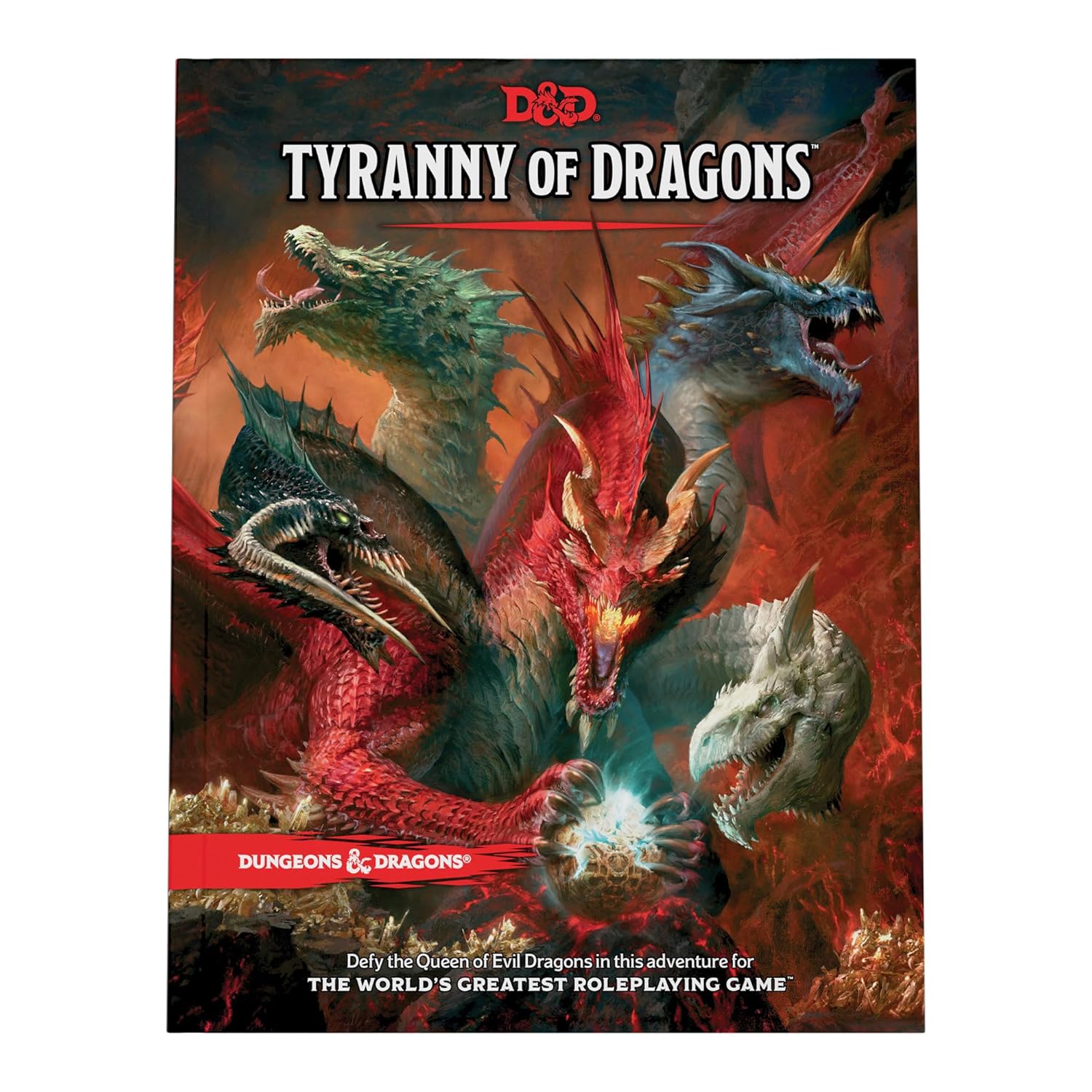
Tyranny of Dragons — the updated, hardcover collection that combines Hoard of the Dragon Queen and The Rise of Tiamat into a single, sweeping campaign.
Spanning levels 1 to 15, this high-stakes epic plunges your players into a continent-spanning war against the Cult of the Dragon and their ultimate goal: to summon the five-headed goddess Tiamat into the world.
After running this entire campaign from beginning to end with two different groups, I’m ready to break down what works, what doesn’t, and why Tyranny of Dragons might be the perfect pick for your next long-form D&D adventure.
What Is Tyranny of Dragons?
Tyranny of Dragons is a combined and revised edition of two linked 5th Edition campaign modules originally released in 2014:
- Hoard of the Dragon Queen – Levels 1–7
- The Rise of Tiamat – Levels 8–15
Together, they form a single, coherent campaign in which the players must thwart the Cult of the Dragon’s plan to gather powerful artifacts, ally with chromatic dragons, and open a portal to the Nine Hells — releasing Tiamat into the Forgotten Realms.
This updated hardcover includes:
- Streamlined transitions between chapters
- Adjusted encounters for smoother pacing
- Rewritten sections for better narrative clarity
- All official errata and stat block fixes integrated
Whether you’re a first-time DM or a veteran looking for a rich, structured campaign to run over the course of many months, Tyranny of Dragons delivers a true “epic fantasy” experience.
Structure and Story Overview
The campaign unfolds in three major acts:
Act I: Hoard of the Dragon Queen
The players begin as lowly adventurers swept up in the chaos of a dragon attack on the town of Greenest. From there, they follow the cult’s trail across the Sword Coast, from swamps and caravans to cloud castles and secret lairs.
This act is all about discovery and pursuit — uncovering the cult’s plans, infiltrating their ranks, and trying to stop them before it’s too late.
Act II: The Rise of Tiamat
The threat becomes global. The cult has gathered powerful allies — including evil dragons and infernal forces — and the world’s factions must band together to resist.
This half of the book emphasizes diplomacy, strategy, and high-level threats, culminating in the campaign’s final stand at the Well of Dragons.
Running the Campaign: A DM’s Perspective
I’ve run Tyranny of Dragons twice — once with newer players and once with experienced tacticians. Here’s what stood out to me as a Dungeon Master:
What Works Well
1. It Feels EPIC From the Start
You’re fighting dragons in the very first session. This isn’t a slow build — it’s “here’s a burning village, here’s a dragon, now go.” My players were immediately hooked.
2. Varied Adventure Styles
There’s dungeon delving (Castle Naerytar), social intrigue (Council of Waterdeep), overland travel (Caravan to Baldur’s Gate), infiltration (Skyreach Castle), and more. It never feels repetitive.
3. Real Consequences
The Council Scorecard lets the players’ actions influence alliances, morale, and the final battle. Will the metallic dragons back you? Will the wizards trust you with the Draakhorn? It’s all up to your decisions.
4. Legendary Villains
From Rezmir the Black to Severin the Red, the cult’s leaders are sinister, theatrical, and deadly. By the time the players confront them, there’s real weight behind those encounters.
5. Tiamat Herself
The final confrontation can include the goddess Tiamat — one of the most iconic villains in D&D history. It’s not just about killing her; it’s about preventing her arrival through strategy, sacrifice, and timing.
What Needs DM Adjustment
No campaign is perfect. Here are some areas where I had to put in some extra work as the DM:
1. Railroading in Early Chapters
Hoard of the Dragon Queen has some linear segments (especially the caravan section) that require finesse to avoid making players feel like passengers. I added side quests and optional character arcs to help.
2. Deadly Encounters for Low Levels
Greenest’s initial invasion and the early cult fights can TPK new groups if you’re not careful. I softened some encounters and used NPCs to redirect aggro when needed.
3. The Council Can Drag
Some sessions during Rise of Tiamat involve heavy exposition and politics. Use handouts, quick summaries, or dramatic events (like an assassination attempt) to spice things up.
4. Weak Player Motivation Without Tie-Ins
To get the most out of this campaign, you need player backstories that connect. I asked my players upfront to tie themselves to a faction, a town, or even a dragonbloodline to raise the stakes.
Factions, Politics, and Big-World Decisions
One of the best parts of The Rise of Tiamat is how much player agency it allows. Players are no longer just adventurers — they’re ambassadors, generals, and symbols of resistance.
The Council of Waterdeep includes NPCs from:
- The Harpers
- The Emerald Enclave
- The Lords’ Alliance
- The Zhentarim
- And more…
Each faction has its own priorities, and how the players act determines which factions commit troops to the final war effort.
At my table, the players sabotaged the Red Wizards’ offer, forged a fragile truce with metallic dragons, and lost the allegiance of one council member due to past crimes. These choices directly impacted the final confrontation.
🛒 Get your copy of Tyranny of Dragons here
Production Quality
This 224-page hardcover is beautifully produced. Highlights include:
- Sturdy binding and premium matte pages
- Updated full-color maps and regional art
- Integrated stat blocks (no flipping to Monster Manual)
- Revised and clarified text from the original 2014 printings
- A helpful index and encounter summaries
The combined format also eliminates the awkward mid-campaign book switch, creating a more cohesive experience for both DMs and players.
Final Verdict
Tyranny of Dragons is a campaign of true scale. With iconic villains, massive set pieces, deep lore, and jaw-dropping final stakes, it’s the kind of adventure players talk about years later.
Yes, it requires some DM elbow grease — especially in Act I — but the payoff is worth it. My players still talk about when they climbed aboard a crashing sky castle, survived a cultist siege, or stared down Tiamat’s emerging form in horror.
For anyone looking for a structured but customizable campaign with dragons galore, Tyranny of Dragons is one of the strongest full-length offerings in 5e.
⭐ Final Rating: 9/10
✅ Incredible enemy variety
✅ Engaging political choices
✅ Legendary final boss
✅ Tons of dragons
❌ Requires some DM rebalancing
❌ Early chapters can feel linear without tweaks
Ready to Defy the Queen of Dragons?
Uncover the cult’s secrets. Rally the Sword Coast. Face the might of Tiamat herself.
🎲 Buy Tyranny of Dragons on Amazon
Adventure doesn’t get more epic than this.
